Adults · B1–B2 · TCF Canada
Le Système CLB 7
CLB 7 in writing is 10 or 11 out of 20. It does not ask for perfect French, it asks for organised French: a plan, five connectors, one concession, and a prompt respected down to the last word. This is that system, task by task.
Written in French, with an English translation of every line
Secure checkout
Instant download · 91-page PDF · Print-ready


Inside the PDF
Inside the 91-page PDF
One file, written in French with an English translation of every line. Here is what is actually printed on those pages.
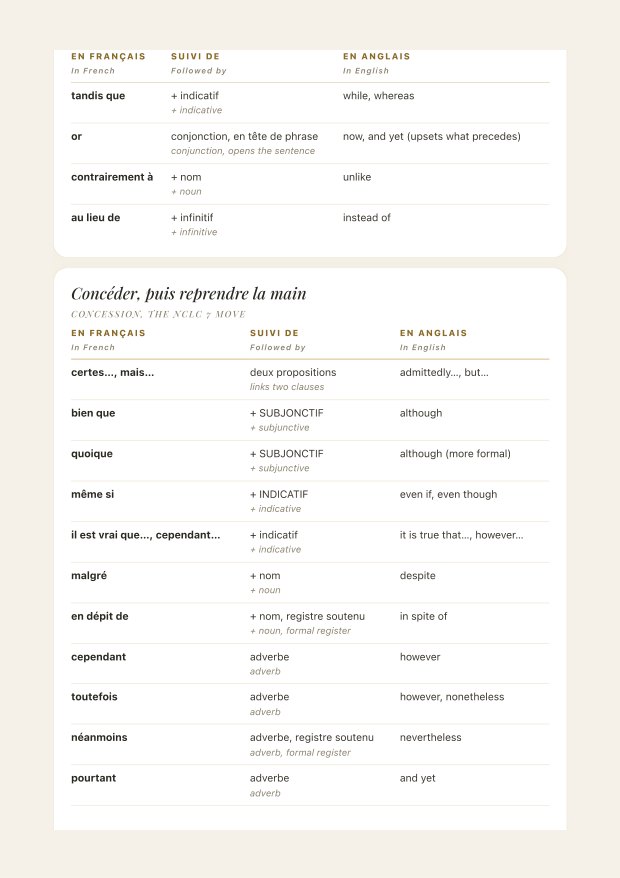
A real page: the concession connectors
91
pages
15
structures
15
model papers
75
prompts
- 1
15 structures, one per situation
An invitation, a cancellation, a complaint, a news item, a portrait, a concession followed by a rebuttal: each one is a plan with its ready-made sentences, so you start writing instead of staring at the prompt.
- 2
15 model papers, each with its word count
Every model shows the count the script measured against the official range (102 words out of 60 to 120), and a note underneath says why that paper holds CLB 7: this concession, that subjunctive, those three separate paragraphs.
- 3
130 connectors sorted by what they do
15 families from cause to closing, and a second column giving the mood each one takes. Bien que and même si both translate as although, but one demands the subjunctive and the other forbids it.
- 4
The 40 mistakes, with the fix next to each
The wrong sentence and the right one side by side: mixing tu and vous in one text, forgetting the past participle agreement with être, writing demander pour instead of demander quelque chose à quelqu'un.
- 5
A rubric that marks like the examiner
Four criteria, three columns (9, 11 and 13 out of 20), and the three rules that stop you marking yourself generously. Average the four rows and you get a mark close to the real one.
- 6
Three checklists you verify by counting
One per task. Not « is my text clear », but how many different connectors, how many subjunctives, how many paragraphs. Every line is checked in under two minutes, with nothing left to judgement.
The exam
Three tasks, one hour
Each task gets the same treatment: five structures to choose from, five model papers in the right length, and twenty-five prompts to write against.
Le message
60 to 120 words · 10 minutes
Inviting, cancelling, asking for information, complaining, giving news and advice. The easiest task to pass and the easiest one to lose, because the prompt always hides three separate things to do.
L'article
120 to 150 words · 20 minutes
The news item, the event report, the personal account, the investigation, the portrait. Five genres, each with its own tenses and its own opening.
L'opinion argumentée
120 to 180 words · 25 minutes
Two parts with separate budgets: 40 to 60 words comparing the two views you are given, then 80 to 120 defending your own. Part 1 is written once in the guide, then five plans for part 2.
15
structures
15
model papers
75
practice prompts
Full content
7 chapters, 91 pages
From what the mark is made of, to the morning of the exam
The mark you actually need
What 10 or 11 out of 20 looks like on paper, how your words are counted, the examiner's four criteria, and a minute-by-minute plan for the hour
The 40 mistakes that sink a paper
The 10 that cost you a whole task, the 15 grammar slips that hold you at 9, and the 15 English calques an anglophone candidate writes without noticing
The connector bankKey chapter
130 connectors in 15 families, each with the mood that follows it, plus the survival table that settles bien que against même si once and for all
Task 1: the message
5 structures, 5 model papers, 25 practice prompts. 60 to 120 words in ten minutes
Task 2: the article
5 structures, 5 model papers, 25 practice prompts. 120 to 150 words in twenty minutes
Task 3: the argued opinion
5 structures, 5 model papers, 25 practice prompts. The two parts and their separate word budgets
Grading your own work
The self-assessment rubric at 9 / 11 / 13 out of 20, three countable pre-submission checklists, a 30-day plan and the exam-morning routine
What separates a 9 from an 11
One point, and a whole immigration file. The papers that get there still contain mistakes. What they contain above all is visible paragraphs, five to seven different connectors, one concession, and a prompt answered in full. The guide shows a 9 and an 11 on the same subject, side by side, so you can see the gap rather than guess at it.
Plan
Pick a structure
Five per task, each with its ready sentences
Write
Hit the range
Upper third of the word count, like the models
Check
Count, don't judge
The checklist verifies in under two minutes
Why it works
Built around what TCF Canada actually rewards
Built around one threshold
CLB 7 in writing means 10 or 11 out of 20. Not perfect French: organised French. Everything in the guide is aimed at that line and nothing else.
Every single line in English too
Prompts, model papers, explanations, connector tables, even the grammar vocabulary. You never lose a point because you misread what the task was asking.
75 prompts, 25 per task
Written in the format of the real exam, on the subjects that actually come up: housing, work, neighbourhood life, school, food, transport, the move to Canada.
Word counts you can trust
Every model paper is counted by the build script, never by hand, and Task 3 shows its two parts separately. It is the first number a candidate checks.
Self-marking without the illusion
A rubric at three levels plus three checklists where every line is verified by counting. You find out where you stand before the examiner tells you.
A 30-day plan, then a reserve
21 prompts at one a day, then 3 full mock exams. The remaining 54 prompts are there for a second month, or for a second sitting.
Simple to use
Thirty days, thirty texts
Learn the system
Chapters 1 to 3 give you the threshold, the 40 mistakes to stop making, and the 130 connectors you will reuse everywhere.
Write one a day
21 prompts, one per day, each time choosing a structure and checking your own paper against the task checklist.
Sit three mocks
Three full papers of three tasks, timed. Then mark yourself on the rubric and see where the point is hiding.
Questions
Frequently asked questions
Which part of the TCF Canada does this cover?
The writing paper (expression écrite) and only that: the three tasks, in order, each with its structures, its model papers and its prompts. It does not cover listening, reading or speaking. That focus is the point: writing is the section where a method changes your mark the most, and the one most candidates are retaking.
What exactly is CLB 7, and what mark does it need?
CLB 7 (NCLC 7 in French) is the level most Canadian immigration programmes ask for. In TCF Canada writing, it corresponds to 10 or 11 out of 20. The guide is built around that threshold: the rubric compares a 9, an 11 and a 13 side by side, so you can see what the single point between them is actually made of.
Do I need to understand French to use it?
No. The guide is written in French because that is the language you have to produce, but every prompt, every model paper, every explanation and even the grammar vocabulary has its English translation right beside it. An anglophone candidate at B1 can read the whole thing without a dictionary.
How is this different from Réussir le TCF?
Réussir le TCF covers the general TCF, speaking and writing together, with themed vocabulary and three full mock exams. This one takes a single paper of a single exam, TCF Canada writing, and goes much deeper: 15 structures, 15 model papers and 75 prompts for three tasks instead of six. If you are sitting the TCF Canada for immigration, start here. Many candidates own both.
Are the model papers the right length?
Yes, and you can check. Each one displays the word count measured by the build script against the official range, and Task 3 shows its two parts counted separately. Every model sits in the upper third of its range, which is where the examiner expects a CLB 7 paper to land.
What format is it, and can I print it?
A single 91-page A4 PDF, laid out for printing. Read it on a phone, a tablet or a computer, or print the connector bank and the three checklists and keep them next to you while you write. No app, no account, no subscription.
Pair it with
Sitting the speaking paper too?
Réussir le TCF covers speaking and writing for the general TCF, with 9 themed vocabulary sheets and 3 full mock exams.
Start today
One point away from your file
15 structures, 15 model papers, 75 prompts and the rubric to mark them. Everything you need, in one file.
Secure checkout
One-time payment · Instant 91-page PDF download · No subscription